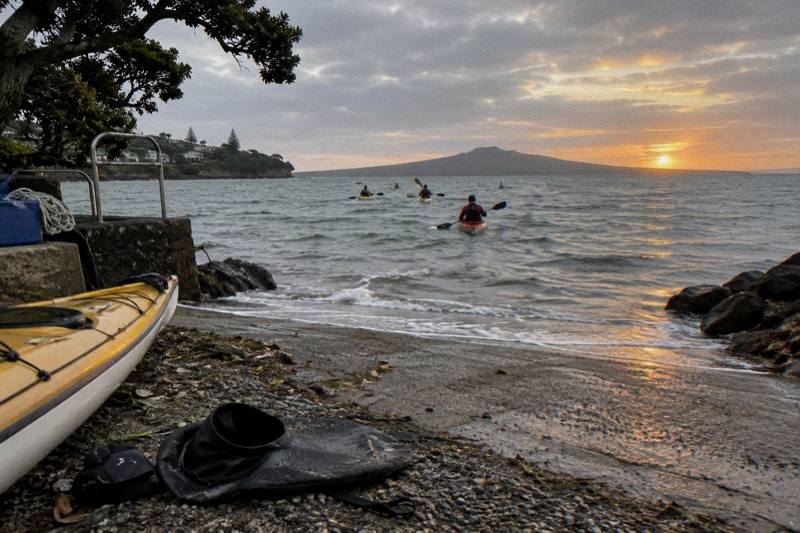
Double Or Single Sea Kayak On An Auckland Tour
Where a guided Auckland paddle states its kayak type, it is a double sea kayak, and that shapes the whole day, from who steers to how tired you get.
Short answer
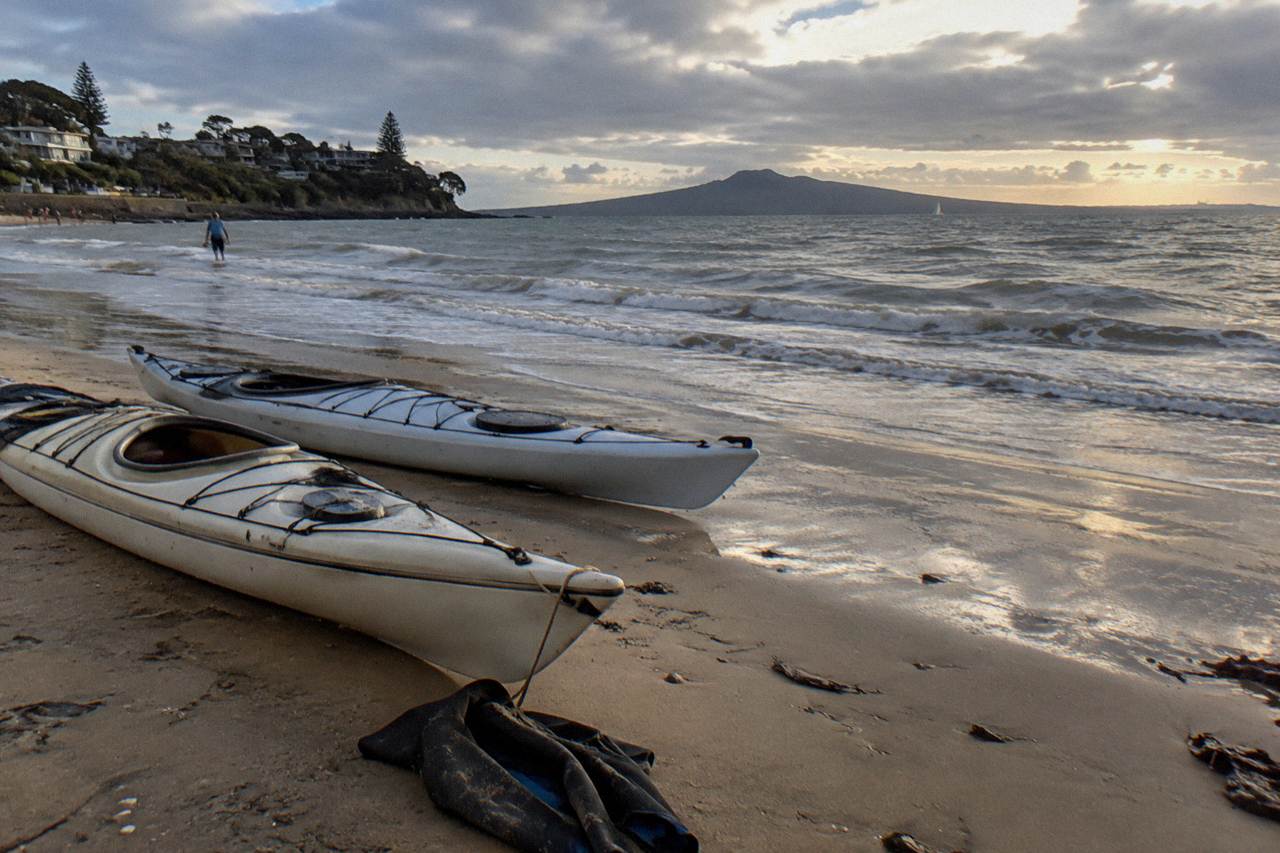
Seven of the fourteen tours covered here state double kayaks, including all five Auckland Sea Kayaks tours, the Tiritiri Matangi day trip and the Goat Island clear-bottom hire. The rest do not name a kayak type on the booking page. No tour guarantees a single kayak, so plan to paddle tandem unless the page says otherwise.
Almost every guided kayak tour out of Auckland puts paddlers in double sea kayaks. It is not a budget shortcut: tandem boats are steadier in the open water of the Hauraki Gulf, easier for a guide to keep together, and friendlier for first-timers than a wobbly single. But it changes the experience, because one person steers, both people share the rhythm, and the seat is a fixed width whether you find it roomy or snug.
This page sets out which Auckland tours use which kayak type, what the booking pages actually say, and what tandem paddling feels like in practice. Where a tour's kayak type is not named on its booking page, that is stated plainly rather than guessed.
Do Guided Kayak Tours In Auckland Use Double Or Single Kayaks?
Doubles, where a kayak type is stated. Seven of the fourteen tours covered here name a double kayak on the booking page: the two Rangitoto tours, the Motukorea half-day, City Lights, City Scenes, the Tiritiri Matangi day trip and the Goat Island clear-bottom hire. The other seven do not state a kayak type, so check with the operator before booking if the boat type matters to you. If you do end up in a tandem, the guide to photographing Rangitoto from a kayak covers dry bags, phone versus camera risk, and the angles you can actually shoot from a double.
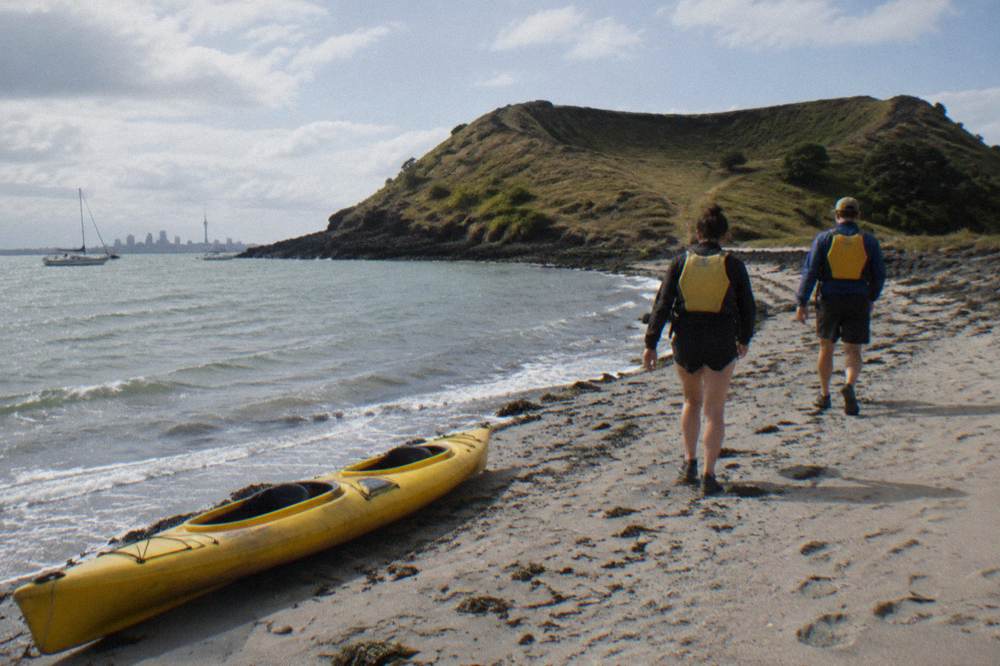
The pattern is easy to read once you see it. Auckland Sea Kayaks, the operator behind five of the tours here, uses double sea kayaks across its public programme, and says so on its own site. Canoe & Kayak Adventures states double kayaks for its Tiritiri Matangi trip, running from Army Bay Beach on the Whangaparaoa Peninsula. Clearyak NZ, the one rental in this group, hires transparent-bottom doubles at Goat Island, up to two people per boat.
For the tours that do not name a kayak type, the honest answer is that the booking page is silent. A Social Nature Movement bioluminescence night paddle, a Browns Island volcano tour or a Riverhead tavern paddle may well run in doubles, but nothing on the page promises it. If paddling a single matters to you, email the operator before you pay rather than assuming.
Here is the full picture in one table:
| Tour | Operator | Kayak type stated |
|---|---|---|
| Sunset kayak tour to Rangitoto Island | Auckland Sea Kayaks | Double |
| Day Sea Kayak Tour of Rangitoto Island | Auckland Sea Kayaks | Double |
| Motukorea / Browns Island half-day | Auckland Sea Kayaks | Double |
| Browns Island Sea Kayak Volcano Tour | Social Nature Movement | Not named on the booking page |
| Night Kayak Tour in Glowing Bioluminescent Waters | Social Nature Movement | Not named on the booking page |
| Bioluminescence Kayak Tour, Est. 1994 | Canoe & Kayak Adventures | Not named on the booking page |
| City Lights Night Kayaking Tour | Auckland Sea Kayaks | Double |
| City Scenes Kayak Tour | Auckland Sea Kayaks | Double |
| Coastal Brewery Kayak Tour | Canoe & Kayak Adventures | Not named on the booking page |
| Riverhead Tavern Kayak Tour | Social Nature Movement | Not named on the booking page |
| Hallertau Clevedon Kayak Tour | Social Nature Movement | Not named on the booking page |
| Tiritiri Matangi Sea Kayak Tour | Canoe & Kayak Adventures | Double |
| 2-Day Waiheke Island Sea Kayak Tour | Social Nature Movement | Not named on the booking page |
| Goat Island Clearyak rental | Clearyak NZ | Double, clear bottom |
One caveat on that last row: the Goat Island hire is the only unguided product here. Everything else on the list is a guided tour, thirteen in total. That matters for kayak type, because a guide can pair paddlers, coach a weaker stroke and keep an eye on a tandem that keeps circling.
If you are still weighing the whole question of which trip suits you, the guide to sea kayaking in Auckland from St Heliers breaks the options down by trip style, and the piece on how fit you need to be for a Rangitoto tour covers the fitness side of a long tandem day.
Is A Double Kayak Easier For A Beginner In Auckland?
Yes, and by a wide margin. A double is wider, steadier and harder to capsize than a single, which is exactly why Auckland operators put beginners in them. One stronger paddler can carry the pace while the other rests, and the guide has fewer boats to shepherd. Auckland Sea Kayaks states beginners are welcome on its tours, no experience needed, and its doubles are the boats those beginners paddle.
The physics is straightforward. Two cockpits mean a longer hull, and a longer hull tracks straighter, so a double does not dart off course every time one paddler pauses. The extra beam gives initial stability that a narrow single cannot match: small waves slap under the hull and the boat shrugs them off. In the chop that can build between St Heliers and the islands, that steadiness is the difference between a nervous two hours and a relaxed one.
There is a social side too. A nervous paddler sitting behind a confident partner gets reassurance without having to ask for it, and parents of teenagers get a captive conversation partner for the crossing. The trade-off is teamwork: two people who fight the rhythm will zigzag, and both will feel it in the shoulders. The guide will coach the pairing at the start, and on many tandems the rear paddler steers, so the steadier paddler often takes the rear seat.
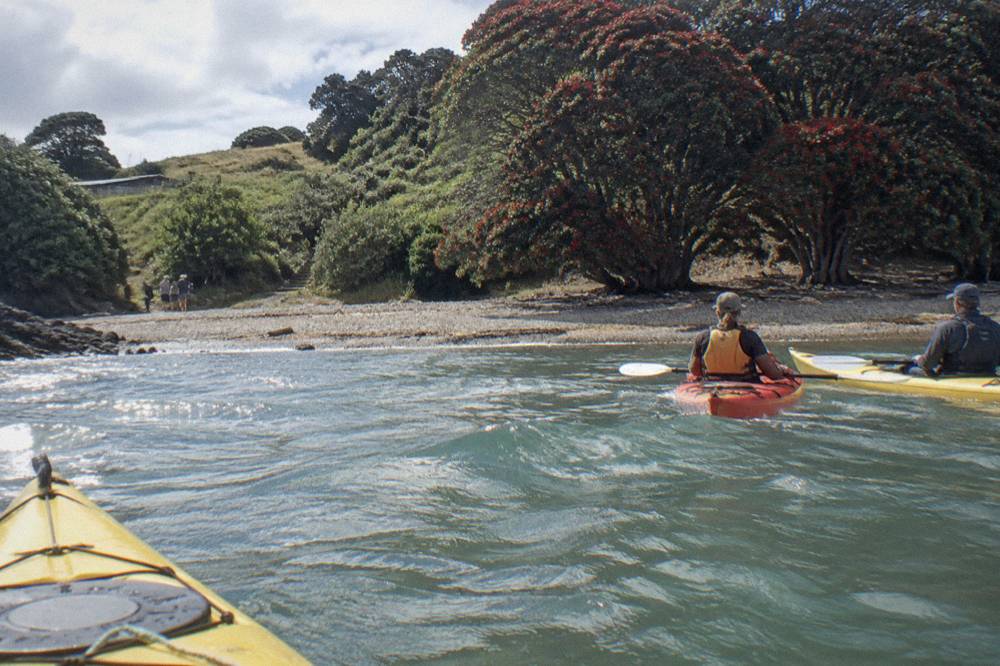
The safety case for doubles is not just operator preference. Since 9 October 2026, Maritime NZ requires everyone on a recreational craft of six metres or less, kayaks included, to wear a properly fitted lifejacket while underway. Guided tours supply the lifejackets, and a tandem makes the guide's head-count and group control far simpler on the water.
For absolute beginners the trade looks like this:
| What matters to a beginner | Double kayak | Single kayak |
|---|---|---|
| Stability | Wider beam, steadier in chop | Narrower, tips more readily |
| Effort | Shared, one paddler can rest | All yours, all day |
| Steering | Rear seat controls the rudder | You do everything at once |
| Capsize risk in guided hands | Lower, guides pair paddlers | Higher for a first-timer alone |
| Independence | None, you must coordinate | Total, but you carry the risk |
If the open-water question worries you more than the kayak-type question, the article on whether a beginner can kayak to Rangitoto works through the guided-versus-independent choice in detail.
Between those two tours you cover the range of Rangitoto days available: a 6 hours 30 minutes sunset crossing with a summit walk, and the same crossing in daylight.
How Does Paddling A Tandem Sea Kayak Actually Work?
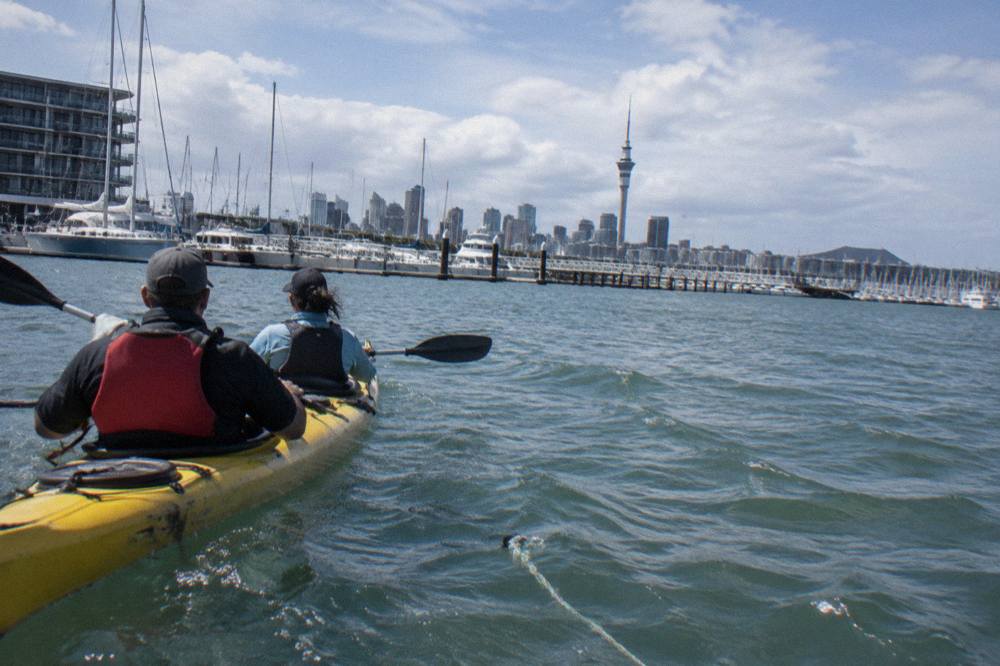
One person sits in front, one behind, and the rear paddler steers with foot pedals connected to a rudder. Both paddle in time, and the guide sets the rhythm and the heading for the group. The rear seat carries more responsibility and the front seat carries the better view, so pick your seat before launch.
The division of labour is the part first-timers underestimate. The front paddler is the engine: they cannot see the rudder, so they set a steady stroke and watch the water ahead. The rear paddler is the driver: they correct course with the pedals, match the front stroke, and listen for the guide. When the guide calls a rest, the front paddler can stop while the rear keeps a light corrective stroke, which is why stronger or more confident paddlers usually go in the back.
Communication is a habit, not a talent. Agree on a call for "stop", "paddle left", "rest", and the boat stops fighting itself. Most pairs find their rhythm within the first twenty minutes, and the boats here are stable doubles, not racing hulls, so the tempo is a walk, not a sprint. Auckland Sea Kayaks notes its tours suit people able to stay seated for up to 45 minutes at a time, with breaks on the water and, on the island tours, a long stop ashore.
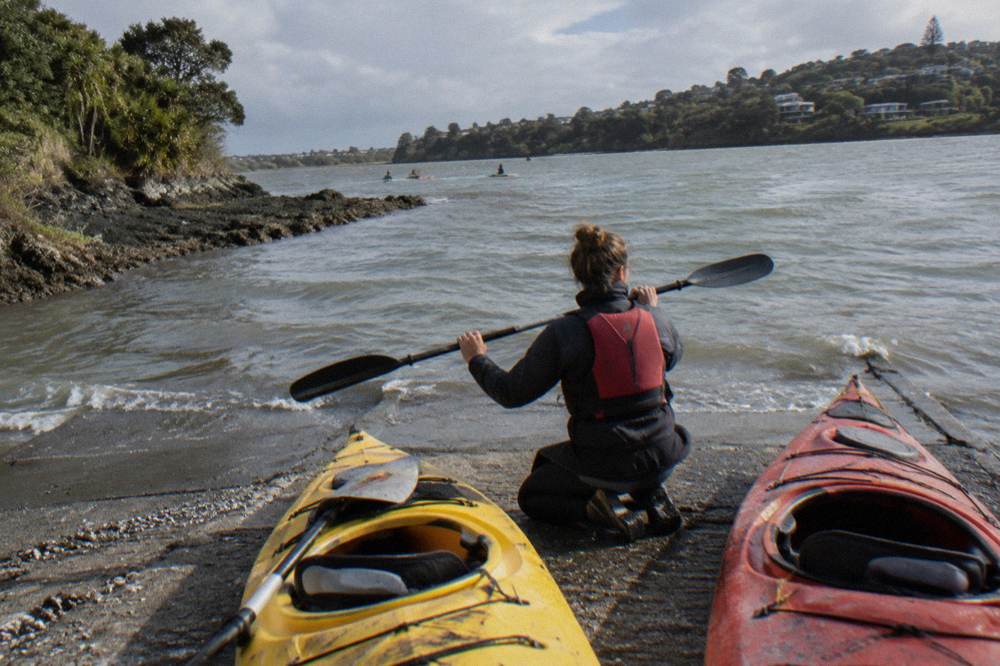
The comfort numbers matter more than people expect. The operator states paddlers must weigh 120 kg or less and fit a seat about 65 cm wide on its tours. That seat width is generous for most adults but worth measuring against your own shoulders if you are broad, because a cramped cockpit turns a six-hour day into a long one. Dress for the seat, not the beach: quick-dry layers, a sun hat and a windproof layer, which the guide on what to wear sea kayaking in Auckland covers in full.
The bioluminescence evening paddle from Canoe & Kayak Adventures, a 2-hour guided trip from $67.59 per person, rated 4.1 across 206 reviews, is a good low-commitment option: a short duration and a guide at a 1-to-6 ratio.
For anyone curious about the failure modes of a tandem, the post on how likely a sea kayak is to flip explains why a loaded double with two paddlers is among the hardest boats on a guided tour to capsize.
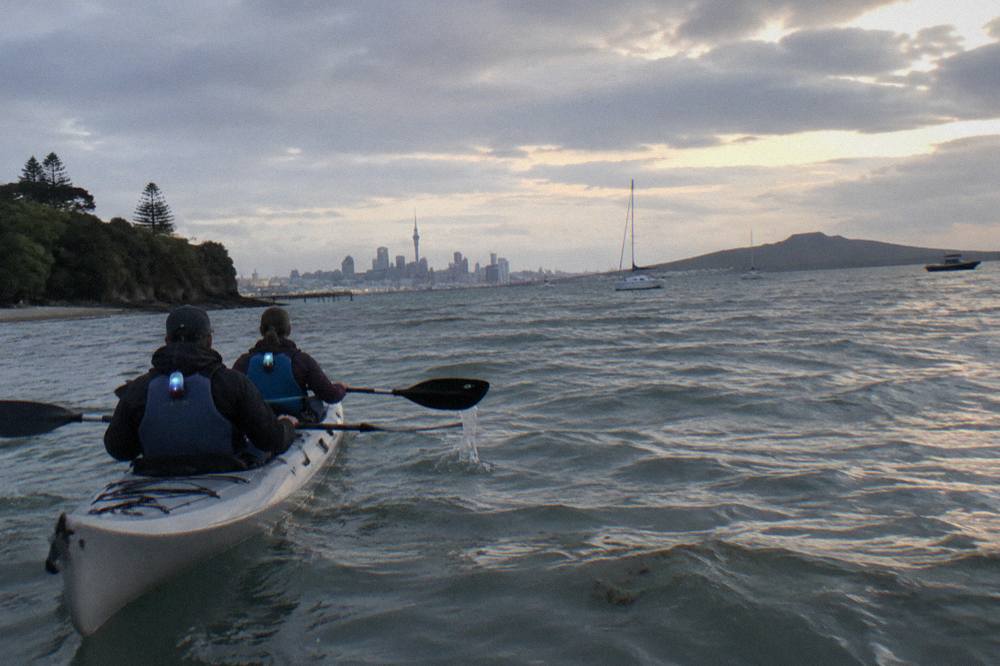
Which Auckland Tours Use Double Kayaks?
Seven tours name doubles outright: the Rangitoto sunset and day tours, the Motukorea half-day, City Lights, City Scenes, Tiritiri Matangi and the Goat Island Clearyak hire. Their durations range from a 30 or 60 minute rental to the 6 to 7 hour Tiritiri Matangi day, and their prices from $72.13 per double kayak at Goat Island to $150.52 per person for the Tiritiri Matangi tour.
Start with the flagship. The sunset kayak tour to Rangitoto Island, from $139.16 per person, runs 6 hours 30 minutes in doubles, rated 4.9 across 179 reviews, with a BBQ dinner and a summit walk included. It launches from St Heliers Bay boat ramp at 384 Tamaki Drive, and a free shuttle from the Auckland War Memorial Museum atrium can be pre-booked, with limited seats. The day version of the same crossing costs the same from price, swaps the dinner for a BBQ lunch, and carries 4.9 across 83 reviews. Both take paddlers aged 14 or over, in groups capped at eight. For a fuller picture of how that rating compares across the city's paddling options, the guide to Auckland kayak tour reviews sorts tours with long review histories from brand-new listings.
The Motukorea half-day is the compact island option: 4 hours, from $110.76 per person, doubles, 5.0 across 38 reviews, morning tea included and a guided summit walk on the island, from age 12. City Lights and City Scenes are the harbour pair, both from $82.36 per person in doubles from Westhaven Marina's Z Pier boat ramp, 2.5 hours each, with minimum ages of 12. Tiritiri Matangi is the long-haul day trip, 6 to 7 hours in doubles from Army Bay Beach, from $150.52 per person, minimum age 13, with just 3 reviews so far.
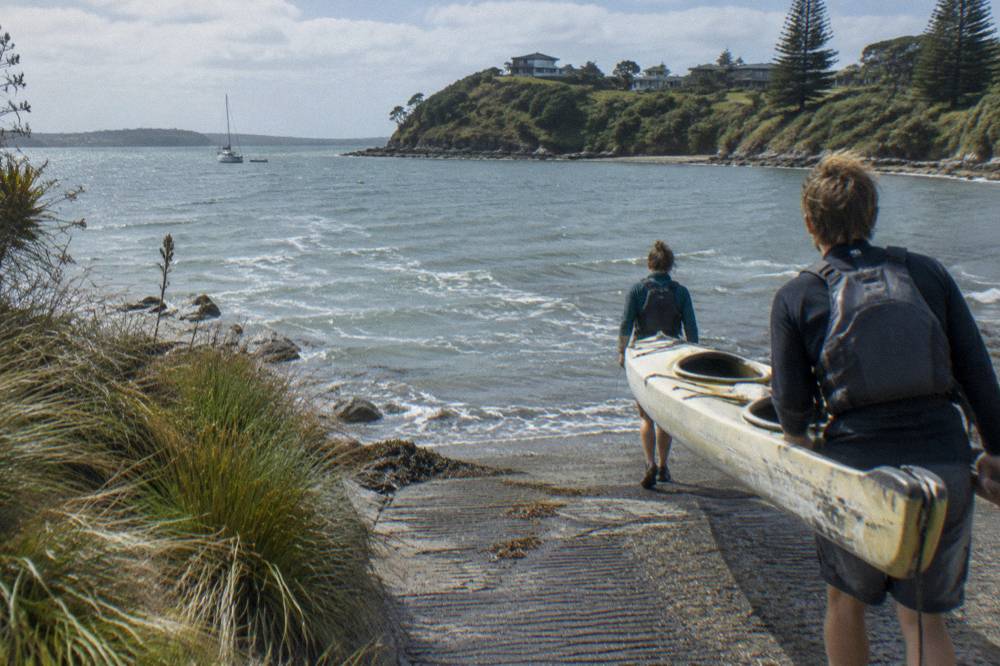
The comparison in one view:
| Tour | Kayak | Duration | Group max | Min age | From (USD) |
|---|---|---|---|---|---|
| Sunset Rangitoto | Double | 6 hours 30 minutes | 8 | 14 | $139.16 per person |
| Day Rangitoto | Double | 6 hours 30 minutes | 8 | 14 | $139.16 per person |
| Motukorea half-day | Double | 4 hours | 8 | 12 | $110.76 per person |
| City Lights | Double | 2.5 hours | 8 | 12 | $82.36 per person |
| City Scenes | Double | 2 hours 30 minutes | 9 | 12 | $82.36 per person |
| Tiritiri Matangi | Double | 6 to 7 hours | 16 | 13 | $150.52 per person |
| Goat Island Clearyak | Double, clear bottom | 30 or 60 minutes | Not given | 3 | $72.13 per double kayak |
The Motukorea half-day deserves a special mention for anyone whose main worry is the tandem itself. It is the highest rated tour here with more than 20 reviews, a perfect 5.0 across 38, it is the shortest of the three island crossings with a summit walk, and its four hours include a long stop ashore where nobody is paddling at all.
Booking the sunset Rangitoto tour means a double kayak, a 6 hours 30 minutes day and the island's summit track, which the Department of Conservation describes as 7 km return with about 250 m of climbing on rough volcanic terrain. The DOC Rangitoto page is worth a read for the island rules: total fire ban, no shops, no rubbish bins, take everything out.
Can You Request A Single Kayak On An Auckland Tour?
None of the fourteen tours states a single kayak. Auckland Sea Kayaks handles disabilities with tandem arrangements or private tours rather than singles, and the guided tours run as group products in doubles where stated. If a single matters to you, the honest route is to ask the operator directly before booking, and accept that the answer may be no.
This is the point where wishful thinking costs money. The booking page is the contract: where it says double, expect double. Where it says nothing about kayak type, the operator may have singles available, but nothing on the page commits them to it.
There are good reasons the guided fleet leans tandem beyond beginner comfort. Guides can count boats, not heads, in a breeze. A paired boat halves the rescue workload if someone tires. And on a crossing like Rangitoto, which DOC describes as accessible to experienced kayakers when done independently, a double means a partner shares the work. For more on that gap, the guide to sea kayak safety in the Hauraki Gulf sets out what guided tours take off your plate.
The one product here that lets you choose your craft is not a tour at all. The Goat Island Clearyak rental is unguided, a double with a clear bottom hired by the boat, and its freedom comes with its own limits: it runs in the warmer season only, so check the operator's website before driving the roughly 1.5 hours north to Leigh. The maximum weight is 100 kg per person and the minimum age is 3, with an adult.
What Should You Know Before Choosing Your Seat?
Pick the rear seat if you want to steer and can keep a rhythm, the front seat if you want the view and a simpler job. Auckland Sea Kayaks asks that paddlers weigh 120 kg or less and fit a seat about 65 cm wide. Agree on steering calls before launch.
The rear seat is the driver's seat. The rudder pedals sit there, the steering calls happen there, and the paddler in it sets the catch that the front seat matches. Choose it if you are the more experienced or more confident paddler of the pair, or simply the one who likes being in charge. The cost is concentration: the rear paddler is working the whole time, reading the guide, correcting course and maintaining the stroke.
The front seat is the photographer's seat. Nothing blocks the view, the bow cuts the water ahead of you, and your only job is a steady, even stroke. Choose it if you would rather follow than lead, or if your partner is the stronger paddler. The cost is trust: you cannot see what is happening behind you, and you will be steering only by agreement.
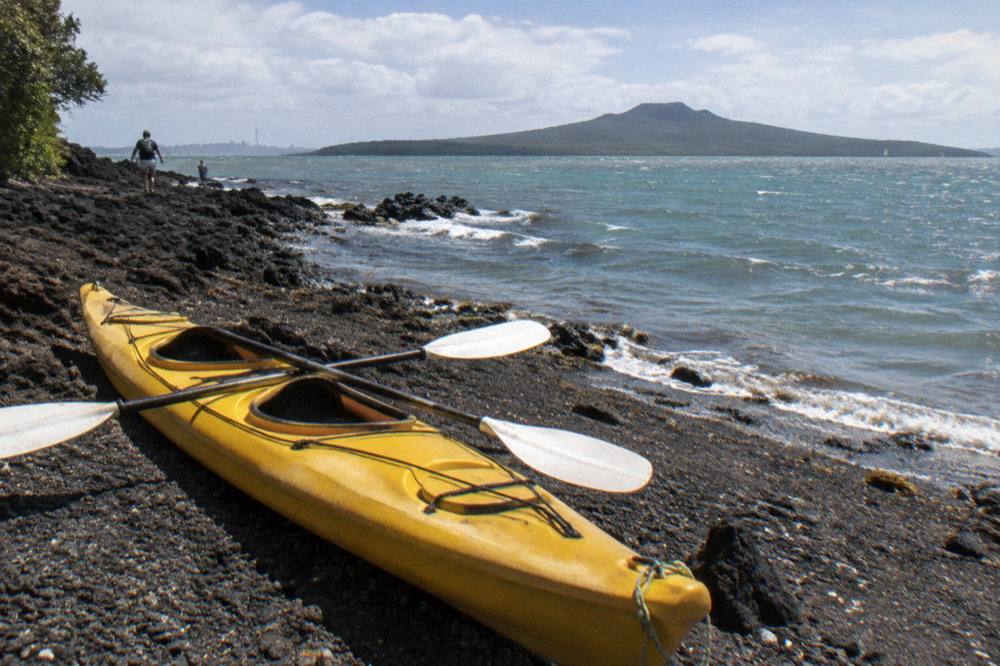
A few seat-adjacent facts worth checking against your own group before you book:
| Check | Auckland Sea Kayaks tours | Goat Island Clearyak hire |
|---|---|---|
| Seat width | About 65 cm | Not given |
| Weight limit | 120 kg | 100 kg per person |
| Minimum age | 12 to 14 depending on tour | 3, with an adult |
| Guided | Yes | No, self-guided rental |
| Time seated | Up to 45 minutes of continuous paddling | 30 or 60 minutes |
Solo travellers can ask the operator how solo bookings are paired. Couples get the obvious answer. A parent with a 12-year-old on the Motukorea tour gets a strong argument for the rear seat and a very proud front paddler.
Cancellation is the last seat-of-the-pants item. The Auckland Sea Kayaks tours state free cancellation up to 24 hours before the start for a full refund on the booking page, but the operator's own terms differ: more than 48 hours before departure, refund less a 25% admin fee, and inside 48 hours, no refund. Read both before booking, and note that if the operator cancels for weather you get a full refund or a reschedule. The deeper version of that story, including what happens when wind stops a tour on the day, is in what happens if an Auckland kayak tour is cancelled for weather.
That is the best moment to swap if the pairing feels wrong. More on the whole day, from parking to the museum shuttle, sits in the Auckland Kayak Tours planning pages, including the guide to the St Heliers kayak meeting point.
Common Questions About Double And Single Sea Kayaks In Auckland
Do Auckland Kayak Tours Use Double Or Single Kayaks?
Seven of the fourteen tours covered here state double kayaks, including all five Auckland Sea Kayaks tours, the Tiritiri Matangi day trip and the Goat Island clear-bottom hire. The other seven do not name a kayak type on the booking page, so plan for a tandem and confirm with the operator if it matters.
Is A Double Kayak Easier For A Beginner In Auckland?
Yes. A double is wider and steadier than a single, one paddler can rest while the other keeps the boat moving, and a guide shepherding four doubles has an easier job than one watching eight singles. Auckland Sea Kayaks states beginners are welcome on its tours with no experience needed.
Can You Request A Single Kayak On An Auckland Tour?
None of the tours here offers a single kayak as a bookable option, and none promises one. Auckland Sea Kayaks handles disabilities with tandem arrangements or private tours. If a single matters to you, ask the operator directly before booking rather than assuming on the day.
Who Sits In Front And Who Sits Behind In A Tandem Kayak?
The stronger or more confident paddler usually takes the rear seat, which holds the rudder pedals and the steering. The front seat has the better view and the simpler job of a steady stroke. Agree on simple calls before launching and swap seats only on land.
What Is The Seat Width And Weight Limit On Auckland Tours?
Auckland Sea Kayaks states paddlers must weigh 120 kg or less and fit a seat about 65 cm wide, and be able to stay seated up to 45 minutes at a time. The Goat Island Clearyak hire sets a 100 kg per person limit. Other operators do not state these figures.
Do Solo Travellers Get Paired With A Stranger Or A Guide?
Some operators pair solo travellers with another solo booking or occasionally with a guide, but no tour here promises either arrangement. Say you are travelling alone when you book and ask how pairing works on that trip.